Private Open Space Zoning in South Africa
In South African town planning, “Private Open Space” (often abbreviated as OS3 in municipal zoning schemes, such as those in the Western Cape or Overstrand Municipality) refers to land zoned for non-public recreational, leisure, or environmental purposes. It is privately owned and may include access controls.
Primary uses typically include:
- Private grounds for sports, play, rest, and recreation.
- Ornamental gardens, pleasure grounds, or golf courses.
- Buildings or structures reasonably required to support these uses (e.g., clubhouses or storage sheds).
This zoning emphasizes preserving green, low-impact areas within urban or suburban settings to promote quality of life, biodiversity, and limited development. Agricultural or farming activities are not primary uses but may be permitted as consent uses (requiring municipal approval) to align with sustainable urban greening initiatives.
Urban farming, in particular, fits this framework as a low-intensity, community-oriented activity that enhances open space without conflicting with recreational goals.
What is Allowed Under “Urban Farming”?
In the context of South African zoning (including private open space), “urban farming” (also called “urban agriculture”) is defined as the cultivation of crops and rearing of small numbers of livestock on relatively small areas within the city, for own consumption or sale in neighbouring markets. This definition comes from standard town planning glossaries used across municipalities, aligning with national guidelines under the Spatial Planning and Land Use Management Act (SPLUMA, 2013).
Urban farming is distinct from large-scale rural agriculture (which falls under dedicated agricultural zones). It promotes food security, sustainability, and urban greening, especially in open space zones where it can serve as a complementary use. Activities must be small-scale to minimize environmental impact, noise, or traffic—typically on plots under 1-2 hectares in urban/suburban areas.
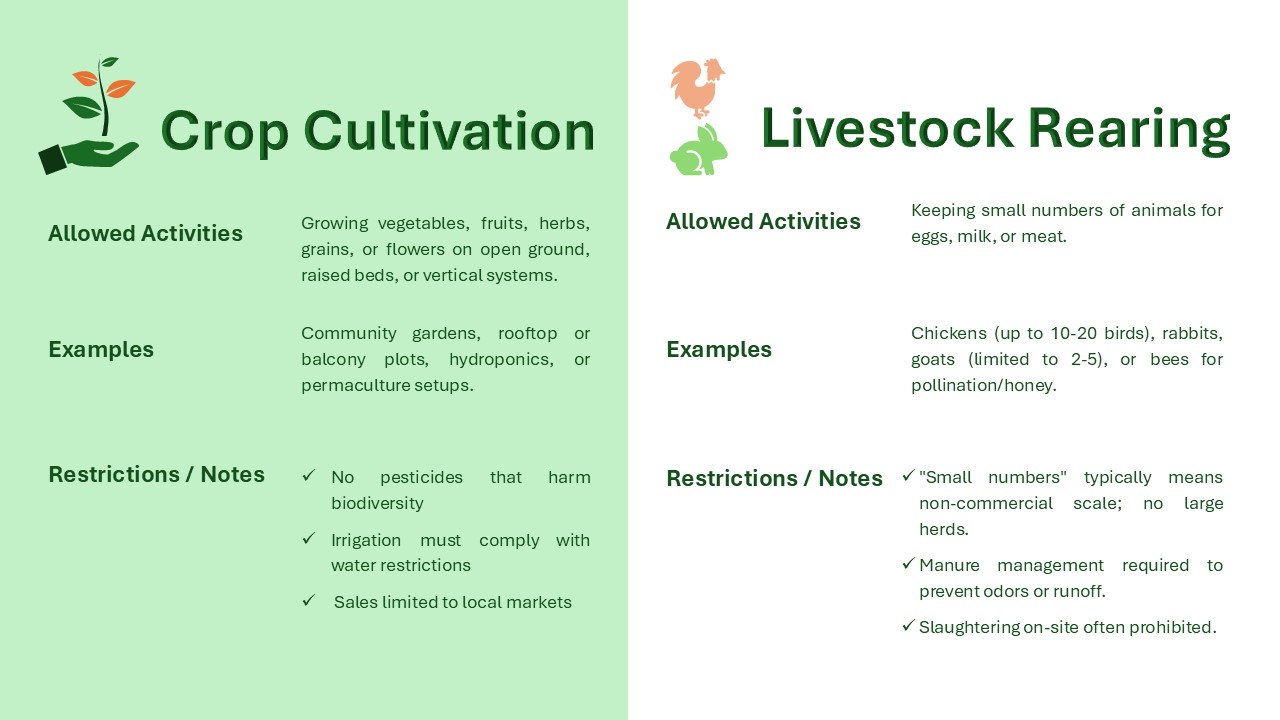
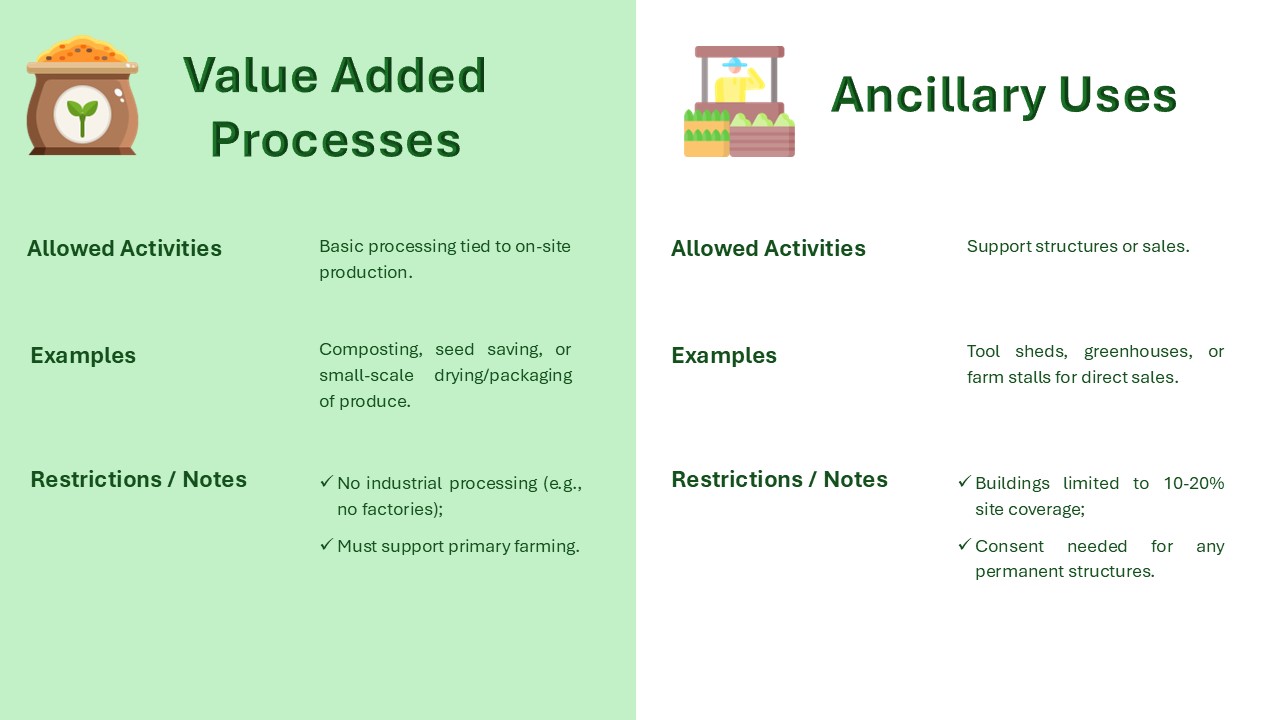
Permitted Activities Under Urban Farming Based on zoning regulations and urban agriculture frameworks, the following are generally allowed (subject to local consent use approval in private open space zones):
Key Considerations for Private Open Space
- Consent Use Requirement:
Urban farming isn’t a default primary use in private open space but can be approved via a consent application to the local municipality (e.g., City of Cape Town or eThekwini). This involves an environmental impact assessment if livestock is involved. - Scale and Impact:
Activities must remain low-density to preserve the zone’s recreational character. Large-scale operations (e.g., commercial orchards) would require rezoning to agricultural. - Benefits in This Zone:
It aligns with urban greening policies, supporting food sovereignty and community health, as seen in initiatives like Cape Town’s ~6,000 urban farmers. - Variations by Municipality:
Rules differ slightly (e.g., Johannesburg may emphasize community gardens, while Western Cape focuses on biodiversity). Always check your local zoning scheme by-law.
For site-specific advice, consult a town planner or your municipality’s development management department, as approvals ensure compliance with SPLUMA and local by-laws.
Below is a practical guide to community garden initiatives under South Africa’s Private Open Space zoning, where urban farming is allowed as a consent use. This focuses on real-world implementation, examples, and step-by-step actions.
What Qualifies as a “Community Garden” in Private Open Space?
Ownership
Privately owned land (e.g., body corporate, school, church, or developer-held open space)
Primary Use
Shared cultivation by multiple households or community groups
Scale
Typically < 1 hectare; plots 5–50 m² per participant
Consent Use
Must be approved by municipality (not automatic)
Infrastructure
Raised beds, compost bays, rainwater tanks, small tool shed (<50 m²)

Step-by-Step:
Launching a
Community Garden
Step | Action | Who Does It | Timeline |
1. Identify Land | Find underused private open space (e.g., vacant erf, school field, retirement village lawn) | Community group / NGO | 1–2 months |
2. Secure Owner Consent | Written permission from landowner (HOA, school board, church council) | Project leader | 1 month |
3. Submit Consent Use Application | Lodge with municipality (Form A + motivation report) | Town planner / community rep | 60–90 days |
4. Design the Garden | Layout, water plan, compost system, access paths | Landscape architect / permaculture designer | 1 month |
5. Fundraise & Partner | Apply for grants (see below), partner with NGOs | Committee | Ongoing |
6. Build & Plant | Install beds, irrigation, signage | Volunteers + contractor | 1–2 months |
7. Govern & Maintain | Form a garden committee, set rules, roster system | Members | Ongoing |
Funding & Support Partners (South Africa)
Organization | Support Offered | Contact |
Soil for Life (Cape Town) | Training, seedlings, compost, mentorship | |
Abalimi Bezekhaya (Cape Town) | Micro-farming training, market access | |
Greenpop | Tree planting, urban greening grants | |
City of Cape Town – Urban Agriculture Grant | Up to R50,000 for tools, water tanks | Apply via ward councillor |
Dept of Agriculture (DALRRD) | Seedlings, training via CASP program | Local extension officer |
Food & Trees for Africa | Fruit trees, permaculture design |
Real South African Examples (Private Open Space)
Project | Location | Land Owner | Size | Key Features |
Oranjezicht City Farm (OZCF) | Cape Town | City + private trust | 0.4 ha | Market, workshops, 100+ members |
VPUU Khayelitsha Gardens | Khayelitsha | Community trust | 0.6 ha | 40 plots, chicken coops, training |
St Francis Community Garden | Durban | Church land | 0.3 ha | 25 families, drip irrigation |
Weltevreden Estate Garden | Stellenbosch | HOA | 0.2 ha | 12 raised beds, compost toilet |
Sample Consent Use Motivation (Excerpt)
“The proposed community garden on Erf 1234 (Private Open Space) will occupy 800 m² (8% of the site).
It supports 15 low-income households with fresh produce, promotes biodiversity through companion planting, and includes a 5,000 L rainwater tank.
No permanent structures exceed 20 m². The project aligns with the municipality’s Urban Agriculture Policy (2021) and Climate Change Strategy.”
Attach:
- Site plan
- Water use calculation
- Letter of owner consent
- List of participants
Rules for Participants (Template)
- No chemical pesticides – organic methods only.
- Water roster – 2 days/week per plot.
- Compost all waste – no municipal bins.
- Max 6 chickens per co-op (if approved).
- Sales limited to on-site farm stall (Fridays 3–6 pm).
Quick Checklist Before Applying
- Landowner written consent
- Neighbour notification (municipal requirement)
- Basic site plan (Google Earth + hand-drawn)
- Water source identified (municipal / rainwater)
- NGO partner for training
- R2,500–R5,000 budget for application fees + planner