
The Lifeblood of the Grove:
A Detailed Look at Palm Forest and Plantation Irrigation
Author: Johan Grabe Founder and CEO Koingnaas Palms
Palm trees, from the dense, wild groves of the Amazon to the meticulously cultivated plantations of Asia and the Middle East, are a vital component of both natural ecosystems and global agriculture.
Their products, ranging from dates and oil to açaí berries, are economic mainstays for numerous communities.
However, the success of both wild and cultivated palms is intrinsically linked to water.
Proper water management and irrigation are critical for their growth, fruit production, and overall health.
This article provides a detailed examination of irrigation practices, contrasting the natural water dynamics of palm forests with the engineered systems used in commercial palm plantations, with a focus on date and oil palms.
Natural Palm Forests: Nature’s Water Managers
In their natural habitat, palm forests are not merely passive consumers of water but active participants in the regional hydrological cycle.
Research has revealed the remarkable ability of palms to act as natural water reservoirs.
A study conducted at São Paulo State University found that palms in the Amazon can store up to 70% of their volume as water, double the capacity of many other tree species.
This makes them, in effect, the “water tanks” of the forest.
This incredible water storage capacity is a key survival strategy, allowing palms to endure periods of drought. By retaining significant water reserves in their trunks, they can maintain vital functions, including fruit production, even when other plants are under stress.
This resilience ensures a consistent food source for a wide array of forest fauna and for human populations who depend on these resources. However, even these natural systems are under threat from climate change, which is intensifying hydrological cycles and leading to more extreme droughts and rainfall, potentially increasing palm mortality rates.
Irrigation of Palm Plantations
The cultivation of palms in plantations requires a more direct and managed approach to irrigation. The goal is to provide a consistent and adequate water supply to maximize yield and quality, a task influenced by a variety of environmental and biological factors.
Factors Influencing Water Requirements
The water needs of a palm plantation are not static. They are influenced by a confluence of factors that determine the rate of evapotranspiration (the loss of water from the soil and the plant to the atmosphere). Key factors include:
- Climate:
Higher temperatures, lower humidity, higher wind speeds, and less cloud cover all increase a palm’s water requirements. - Soil Type:
The soil’s ability to retain water is crucial. Sandy soils, for instance, drain quickly and require more frequent irrigation. - Soil Salinity:
In areas with saline soil, additional water is necessary to leach salts away from the root zone. - Palm Age and Species:
Water needs vary significantly between young plantlets and mature trees, as well as between different palm species like date and oil palms.
Understanding the root structure is also fundamental to effective irrigation. For mature date palms, approximately 70% of the roots are found in the top meter of soil, meaning irrigation must be targeted to this zone to be effective.
Irrigation Methods: From Tradition to Technology
A range of irrigation techniques are employed in palm plantations, each with distinct advantages and disadvantages.


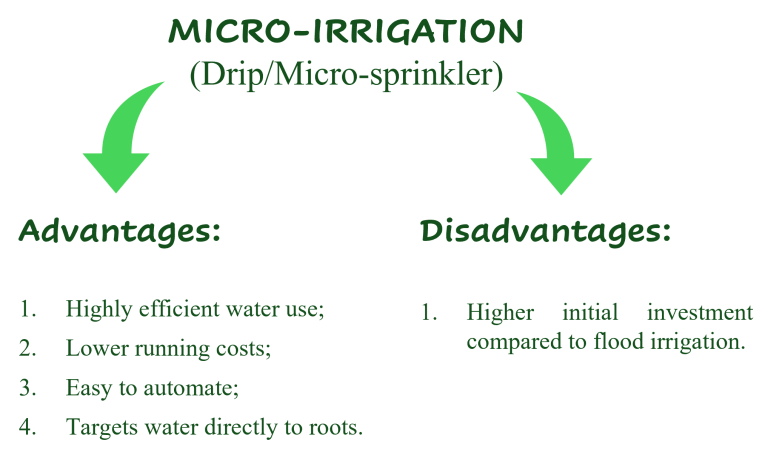
Modern plantations are increasingly shifting from traditional flood irrigation to more efficient micro-irrigation systems to conserve water and improve yields.
Species-Specific Irrigation Practices
Date Palms (Phoenix dactylifera)
Date palms are famously thirsty trees. Traditional flood irrigation is common in many date-growing regions, with annual water application rates varying widely, as shown in the table below.
Region | Annual Water Quantity (m³/ha) |
Algeria | 15,000 – 35,000 |
California, USA | 27,000 – 36,000 |
Egypt | 22,300 |
Iraq | 15,000 – 20,000 |
Tunisia | 23,600 |
Source: FAO 1 |
However, research demonstrates the superior efficiency of modern methods. A study in a semi-arid region of Egypt found that date palms under a drip irrigation system achieved the same yield with only 80% of the water required by those under a sprinkler system.
This highlights the significant water-saving potential of drip irrigation for sustainable date palm cultivation.
Oil Palms (Elaeis guineensis)
Oil palms require continuous soil moisture for vigorous growth and high yields.
It is estimated that an oil palm needs 120-150 mm of water per month to meet its evapotranspiration needs.
Water deficiency can severely impact development, leading to the production of more male flowers and thus a lower fruit yield.
For oil palm plantations, especially in areas with undulating terrain or seasonal water scarcity, drip irrigation is highly recommended. A typical setup involves four drippers per palm, supplying at least 90 liters of water per palm per day during the dry summer months.
Other precision methods like micro-sprinklers and basin irrigation are also used, with drip irrigation being the most economical choice.
Modern Irrigation Management
Beyond the choice of irrigation system, modern technology offers powerful tools for optimizing water use.
Satellite-based monitoring, for example, utilizes indices like the Normalized Difference Moisture Index (NDMI) to assess soil moisture levels across a plantation.
This allows growers to identify areas experiencing water stress and apply water with precision, a practice known as precision irrigation.
This data-driven approach helps to ensure that palms receive the optimal amount of water, improving crop health and maximizing yield while conserving a precious resource.
From the self-regulating water economy of a natural palm forest to the high-tech precision of a modern plantation, the relationship between palms and water is a complex and critical one.
While natural palm groves showcase remarkable adaptations for water storage and drought resilience, cultivated plantations must rely on human ingenuity to supply their needs.
The clear trend in palm agriculture is a move away from inefficient, traditional methods like flood irrigation towards highly efficient micro-irrigation systems.
By combining these advanced systems with data-driven management practices, growers can ensure the long-term sustainability and profitability of palm cultivation, securing the future of this vital global resource.