
The Coconut Rhinoceros Beetle: Detecting and Mitigating Damage to Palms
Coconut palms, symbols of tropical abundance and cultural significance, face a formidable foe in the coconut rhinoceros beetle (Oryctes rhinoceros), a large scarab beetle notorious for devastating palm plantations across Asia, the Pacific, and beyond.
Native to Southeast Asia, this invasive pest was first introduced to Samoa in 1909 via contaminated shipping materials and has since spread to over 30 islands and territories, including Guam, Hawaii, Fiji, and Papua New Guinea.
In Hawaii alone, where it arrived in 2013, the beetle has prompted multimillion-dollar response efforts, with fiscal year 2025 budgets allocating $2.4 million for control.
While mature palms can sometimes recover, young trees are especially vulnerable, and unchecked infestations can kill up to 50% of palms within a decade, slashing coconut yields by 10-40% and threatening livelihoods dependent on this “tree of life.”
This article delves into the biology of O. rhinoceros, methods for early detection, the extensive damage it inflicts on palms, and proven integrated pest management (IPM) strategies to curb its spread.
Understanding the Coconut Rhinoceros Beetle
Oryctes rhinoceros, also known as the Asiatic or coconut palm rhinoceros beetle, belongs to the family Scarabaeidae, subfamily Dynastinae.
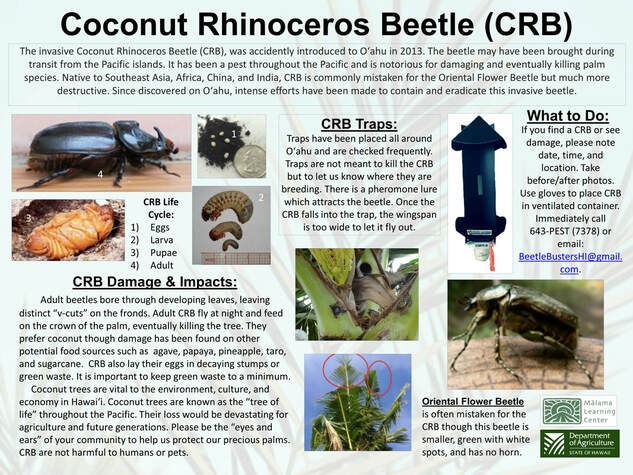
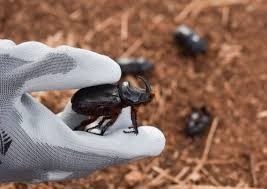
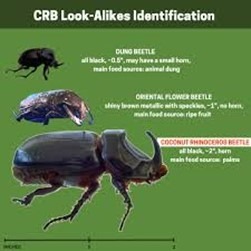
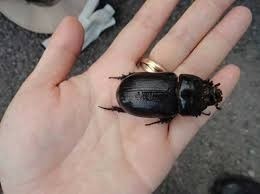
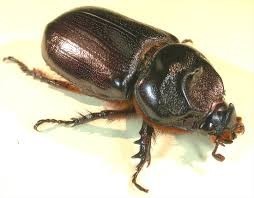
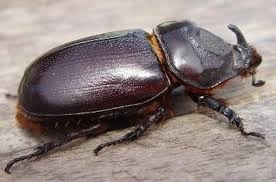
Adults measure 35-50 mm (1.4-2 inches) long, with a shiny black or dark brown exoskeleton and a prominent, curved horn on the head—longer and more pronounced in males, used for mating battles.
Females have a shorter, subtler horn.
These nocturnal fliers can travel up to 2 miles in search of food and mates, emitting a hissing squeak when disturbed by rubbing their wings against the thorax.
The life cycle spans 4-9 months, influenced by temperature (optimal at 30°C/86°F) and food availability, with 1-3 generations per year in tropical climates.
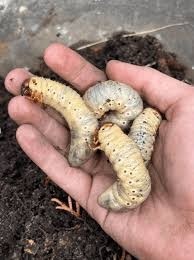
Gravid females lay 50-150 yellowish-white eggs (3 mm diameter) in decaying organic matter like palm logs, stumps, mulch, or compost piles. Eggs hatch in 7-13 days into cream-colored, C-shaped larvae (grubs) that grow up to 75 mm (3 inches) long over 3 instars, feeding voraciously on rotting wood for 3-6 months.
Pupation occurs in earthen cells within the breeding substrate, lasting 15-45 days, before adults emerge to feed and reproduce.
Larvae are the longest-lived stage, but adults cause the most direct damage.
The beetle targets over 20 palm species, with coconut (Cocos nucifera) as the primary host, but it also attacks oil palm (Elaeis guineensis), date palm (Phoenix dactylifera), royal palm (Roystonea regia), and native Hawaiian loulu (Pritchardia spp.).
It has expanded to non-palms like banana, sugarcane, papaya, pineapple, taro, and hala (Pandanus tectorius*).
A virus-resistant biotype (CRB-G) has emerged since the 2000s, evading classical biological controls and fueling invasions in places like Guam and Hawaii.
Natural enemies in native ranges—parasitic wasps, scoliid wasps, ants, rats, pigs, and pathogens like Metarhizium anisopliae fungus—often keep populations in check, but in new environments, human-mediated spread via infested green waste exacerbates outbreaks.
Detecting the Coconut Rhinoceros Beetle:
Signs of Infestation
Early detection is crucial, as adults are elusive and larvae hide in soil or debris.
Infestations often go unnoticed until frond damage appears, but routine scouting can prevent escalation. Focus inspections on young palms (under 10 years old) during warm, humid months (June-September in the tropics).
Key Visual Indicators
- Boreholes in Crowns:
The hallmark sign is 1.5-2 inch (4-5 cm) round holes at the top of the trunk or base of emerging fronds, where adults burrow to feed on sap. These may ooze liquid or be surrounded by frass (sawdust-like excrement) and coconut fibers. - V-Shaped Notches on Fronds:
As damaged leaves unfurl, look for distinctive upside-down or right-side-up V-cuts, triangular tears, or geometric notches along the midrib—up to several inches deep—caused by adult feeding. Fronds may wilt, break off, or show “scissor-cut” edges. - Frass and Oozing:
Fibrous, brown frass piles at borehole entrances, often with a fermented odor from sap leakage. - Adult Beetles:
Spot large, horned black beetles (2 inches long) at dusk near crowns; they fly clumsily and drop when approached. Distinguish from look-alikes like the smaller oriental flower beetle (Protaetia orientalis), which lacks a horn and has green metallic sheen. - Larval Signs:
In breeding sites, find C-shaped, cream-colored grubs (up to 3 inches) in decaying matter; they crawl on their sides (unlike other grubs that roll over).
Inspection Tips
Scout every 1-2 weeks:
Use a flashlight at night for adults, and probe boreholes with a hooked wire to extract and crush beetles.
Check high-risk sites like ports, nurseries, and green waste piles.
In Hawaii, report suspicions to the state pest hotline (808-643-7378) or CRB Response team for confirmation via molecular testing for biotypes.
Acoustic sensors detecting larval chewing are emerging tools in research settings.
Differentiate from similar damage by red palm weevil (straighter tunnels) or wind shear (irregular tears).
The Damage Caused by the Coconut Rhinoceros Beetle
Only adults damage living plants; larvae harm only decaying matter but enable population booms by breeding prolifically.
Beetles chew into unopened “spear” fronds using horn and mandibles, consuming sap and tissue while creating tunnels up to 1 meter long.
Types of Damage:
Direct Feeding Injury:
Boreholes and V-notches reduce photosynthetic area by 20-50% per frond, stunting growth and causing leaflets to yellow, wilt, or snap off.
In severe cases, the growing meristem (heart) is destroyed, killing the palm outright—especially in saplings under 5 years old.
Physiological and Yield Losses:
Reduced leaf area cuts nut production by 10-40%, with correlations showing one damaged frond equating to 5-10 fewer nuts annually.
In Samoa, historical outbreaks halved yields; in Palau, 50% of palms died within 10 years post-invasion.
Secondary Complications:
Open wounds invite bacteria (Erwinia spp.), fungi (e.g., Thielaviopsis causing bud rot), and other pests, accelerating decline.
In Hawaii, infested crowns have fallen, posing safety risks and prompting removals of 80+ municipal palms in 2024.
Ecosystem and Economic Toll:
Beyond coconuts, attacks on native loulu threaten biodiversity; in Pacific economies, losses exceed millions annually in replanting and lost copra.
Cumulative damage weakens palms to storms, compounding issues like those post-Typhoon Dolphin on Guam.
Young, stressed, or isolated palms suffer most, but even mature trees can die after repeated attacks (3-5 beetles per crown).
Mitigation and Control Strategies
No single tactic eradicates CRB, but IPM—blending cultural, mechanical, biological, and chemical methods—has reduced populations by 95% in managed areas like Oahu’s Mamala Bay.
Prioritize breeding site destruction, as one log can produce 100+ adults.
Cultural Practices
Remove and chip/solarize decaying wood, stumps, and green waste; avoid composting palms without heat treatment (160°F for 10 days).
Plant beetle-resistant varieties or intercrop with legumes to suppress breeding.
Effectiveness:
High (preventive)
Essential foundation of IPM; in Samoa, sanitation cut damage 80%. Cover compost piles.
Mechanical Controls
Use pheromone bucket traps (e.g., ethyl 4-methyloctanoate lures) for monitoring/mass trapping; hook beetles from crowns; net short palms (<10 ft) with fine mesh.
Effectiveness:
Moderate to high
Traps catch 20-50 beetles/site/month; deploy 1-2 per hectare. Destroy captured adults.
Biological Controls
Release Oryctes rhinoceros nudivirus (OrNV) for susceptible biotypes; apply Metarhizium anisopliae fungus to breeding sites. Conserve predators like scoliid wasps and ants.
Effectiveness:
High for OrNV-S; variable for CRB-G
OrNV reduced damage 90% in Fiji; emerging strains target CRB-G. Avoid broad-spectrum sprays.
Chemical Options
Inject systemic insecticides (imidacloprid, acephate) into trunks; foliar spray carbaryl or essential oils (e.g., 6% eucalyptus citriodora) post-pruning.
Effectiveness:
Moderate
Use as last resort; rotate to prevent resistance. Effective on young trees but labor-intensive.
In Hawaii and Pacific islands, community programs emphasize green waste regulations and trap networks.
Research into drone-applied biopesticides and essential oil repellents shows promise for landscapes.
For outbreaks, consult local extensions like the University of Hawaii CTAHR or SPC for biotype-specific plans.
Protecting Palms from the “Palm Killer”The coconut rhinoceros beetle’s relentless boring can transform thriving palm groves into skeletal remnants, but vigilance and IPM offer hope.
By spotting boreholes and V-cuts early, destroying breeding sites, and leveraging biocontrols, communities—from Samoan villages to Hawaiian shorelines—can reclaim their palms.
As climate change intensifies pest pressures, collaborative efforts like Hawaii’s CRB Response underscore the need for global biosecurity.
Whether for copra, culture, or canopy shade, safeguarding these icons demands action today—report, remove, and restore to ensure palms endure for generations.