
Combating the South American Palm Weevil (Rhynchophorus palmarum):
Detection and Management Strategies
The South American Palm Weevil (SAPW), Rhynchophorus palmarum (Linnaeus, 1758), is a devastating invasive pest of palms native to Central and South America.
It has spread to the Caribbean, parts of North America (California, Texas), and poses a serious quarantine threat to Africa, including South Africa.
SAPW primarily attacks coconut palms (Cocos nucifera), African oil palms (Elaeis guineensis), and date palms (Phoenix dactylifera), causing crown collapse and tree death within months. In South Africa, where oil palm cultivation is expanding in KwaZulu-Natal and Limpopo, and ornamental palms are widespread in urban landscapes, early detection and aggressive containment are critical.
This article details science-based detection methods and integrated remedies to combat SAPW.
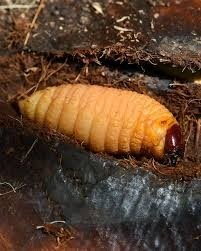
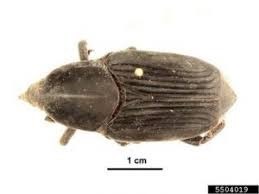
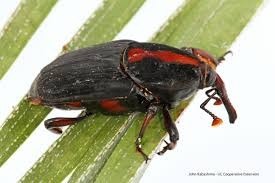

Biology and Life Cycle of the South American Palm Weevil
SAPW shares similarities with the Red Palm Weevil but differs in host range, behavior, and disease transmission.
- Adult Stage:
Large (3.5–5 cm), glossy black weevils with a long, curved snout. Males have a comb-like row of stiff hairs (the “mustache”) on the dorsal snout surface. Strong fliers; active at dusk. - Egg Stage:
Females lay 200–700 white, oval eggs (≈3 mm) in chewed cavities in the crown, leaf bases, or wounded trunk tissue. - Larval Stage:
Creamy-white, legless grubs with reddish-brown heads grow up to 6 cm. They tunnel deep into the palm heart, feeding on meristematic tissue and creating frass-filled galleries. - Pupal Stage:
Larvae construct oval cocoons from palm fibers, usually in the crown or at the base of fronds. Pupal duration: 10–20 days. - Total Life Cycle:
60–120 days, with 3–4 overlapping generations per year in tropical climates (optimal 27–32°C).
Key Difference from RPW:
SAPW is a vector of the red ring nematode (Bursaphelenchus cocophilus), which causes red ring disease—a lethal wilt syndrome in coconut and oil palms. Even low weevil populations can trigger devastating nematode outbreaks.
Early Detection Methods
SAPW infestations are cryptic—larval damage occurs internally. External symptoms appear only in late stages. A multi-layered detection system is essential.
Visual Inspection (Routine & Critical)
- Early Symptoms (often missed):
- Slight yellowing or drooping of central spear leaf.
- Small holes (5–8 mm) with oozing sap or reddish-brown frass at leaf axils.
- Chewed leaf bases; fronds break easily at the petiole.
- Advanced Symptoms (tree likely unsalvageable):
- Crown collapse; “umbrella” or “telephone pole” appearance.
- Reddish ring in cross-section of trunk (3–5 cm wide) due to nematode infection.
- Foul odor from fermenting tissue.
- Best Practice:
- Inspect every 2 weeks during warm, wet seasons.
- Use pole pruners to remove and dissect central fronds.
- Check base of fronds for cocoons (oval, fibrous, 5–7 cm long).
Pheromone Trapping (Primary Monitoring Tool)
- Aggregation Pheromone: Palmitol (4-methyl-5-nonanol) + host kairomones (fermenting palm tissue).
- Trap Design:
- Black bucket traps (12–15 L) with rough surface and 4–6 entry holes.
- Add pheromone lure + piece of sugarcane or decaying palm tissue + water + insecticide (e.g., cypermethrin).
- Service weekly; replace lures every 8–12 weeks.
- Placement:
- 1 trap per 1–2 ha; 50 m apart; ground level or 1 m high.
- Place near stressed or recently pruned palms (attractants).
- Effectiveness:
- Captures both sexes; up to 90% reduction in local populations with mass trapping.
- Early warning: Trap counts spike before visual symptoms.
Acoustic Detection (High Precision)
Larvae produce loud chewing and scraping sounds inside the trunk.
- Tools:
- AED-2010 or SAPW-Detector sensors with AI signal analysis.
- Smartphone apps (e.g., WeevilSound AI) using external microphones.
- Procedure:
- Attach sensor at 0.5 m and 1.5 m height.
- Record 1-minute samples in silence.
- Software identifies SAPW-specific acoustic signatures (>85% accuracy).
Advantage: Detects larvae 4–6 weeks before crown collapse.
Sniffer Dogs (Proven in Americas)
- Trained dogs detect SAPW volatile organic compounds (VOCs) at infestation levels too low for traps.
- Used successfully in California (USDA-APHIS program).
- One dog screens 300 palms/day; accuracy >97%.
Nematode Symptom Surveillance
- Red Ring Disease Indicators:
- Yellowing older fronds → bronzing → death.
- Cross-cut trunk reveals red-orange ring (3–5 cm wide).
- Lab Confirmation:
Extract nematodes from tissue using Baermann funnel.
Remote & Tech-Enabled Detection
- Drone Thermal Imaging:
Larval galleries create heat anomalies. - Multispectral Drones:
Detect chlorophyll loss (NDVI drop) in canopy. - Ground-Penetrating Radar (GPR):
Experimental for tunnel mapping.
Integrated Pest Management (IPM) Remedies
SAPW control requires area-wide, synchronized action due to its flight capacity and nematode vectoring.
Preventive (Cultural) Practices
- Sanitation:
- Remove and destroy infested palms within 24 hours (chip + burn or bury >1 m deep).
- Treat stumps with kerosene or chlorpyrifos to kill hidden larvae.
- Wound Avoidance:
- Prune only in cool, dry seasons; seal cuts with bitumen paint.
- Avoid transporting palm material without heat treatment (60°C for 30 min).
- Quarantine:
- Mandatory inspection of imported palms.
- South Africa: Report to DAFF Pest Reporting Hotline (0800 111 339).
Mechanical Control
- Trap Trees:
- Fell healthy palms, leave for 2 weeks to attract weevils, then destroy.
- Fell healthy palms, leave for 2 weeks to attract weevils, then destroy.
- Crown Drenching:
- Pour insecticide + surfactant into crown to reach hidden larvae.
Chemical Control (Targeted & Rotational)
Systemic Insecticides:
Emamectin benzoate:
Trunk injection.
Duration: 12 months.
Imidacloprid + Thiamethoxam:
Soil Drench and Injections.
Duration: 6 – 9 Months.
Acephate:
Crown injection.
Duration: 3 Months.
- Protocol:
- Confirm infestation (pheromone + acoustic).
- Inject 1 ml product per cm trunk diameter at 30 cm height.
- Repeat every 4–6 months.
- Confirm infestation (pheromone + acoustic).
- Nematode Control:
- No chemical cure once red ring appears.
- Prevent via weevil control.
- No chemical cure once red ring appears.
Biological Control
- Entomopathogenic Nematodes (EPNs):
- Steinernema riobrave, Heterorhabditis indica.
- Apply 2–3 million IJs/palm via crown irrigation.
- Efficacy: 80–95% in humid conditions.
- Fungal Pathogens:
- Beauveria bassiana (strain RPAL-1) – spray on wounds/traps.
- Metarhizium anisopliae – soil application.
- Parasitoids:
- Billaea rhynchophorae (tachinid fly) – under evaluation in Brazil.
Semiochemical & Advanced Tools
- Mass Trapping + Push-Pull:
- Pheromone traps (pull) + repellent sprays (e.g., neem oil) on healthy palms (push).
- Pheromone traps (pull) + repellent sprays (e.g., neem oil) on healthy palms (push).
- Sterile Insect Technique (SIT):
- Gamma-irradiated males released to crash populations (piloted in Mexico).
- Gamma-irradiated males released to crash populations (piloted in Mexico).
- RNAi Sprays:
- dsRNA targeting SAPW actin genes – experimental (CINVESTAV, Mexico).
Action Plan for South African Stakeholders
Phase:
Prevention
Action:
Deploy pheromone traps; train staff in visual/acoustic checks
Timeline:
Ongoing
Phase:
Early Detection
Action:
Use dogs or sensors on high-value palms (e.g., urban Durban)
Timeline:
Monthly
Phase:
Confirmed Infestation
Action:
Inject emamectin + apply EPNs; remove palm if >50% crown lost
Timeline:
Within 48 hrs
Phase:
Eradication
Action:
Chip + burn; treat 500 m radius with traps + insecticide
Timeline:
1 week
Phase:
Monitoring
Action:
Weekly trap counts; report to DAFF
Timeline:
Continuous
The South American Palm Weevil is a dual threat: a structural destroyer and a nematode vector.
In South Africa, pheromone trapping and acoustic detection offer the best early warning.
Combine with sanitation, targeted injections, and biological agents in an IPM framework to protect oil palm plantations and urban greenery.
Community coordination—via DAFF, municipal biosecurity teams, and farmer cooperatives—is non-negotiable.
A single missed palm can seed an outbreak costing millions. Act fast, monitor relentlessly, and integrate tools for sustainable control.
References:
FAO (2024), EPPO Global Database, USDA-APHIS SAPW Program, Journal of Economic Entomology, Pest Management Science, South African DAFF Pest Risk Analyses.