
Palm Weevils (Genus Rhynchophorus)
Palm weevils are widely considered the most destructive pests of palms globally.
The larvae of these large beetles tunnel into the heart of the palm, destroying the apical meristem (the growing point), which inevitably leads to the death of the tree.
Infestations are often difficult to detect in their early stages, making control and eradication challenging.

Combating the Red Palm Weevil (Rhynchophorus ferrugineus):
Detection and Management Strategies
The Red Palm Weevil (RPW), Rhynchophorus ferrugineus (Olivier, 1790), is one of the most destructive invasive pests of palm trees worldwide.
Native to Southeast Asia, it has spread to over 60 countries across the Middle East, North Africa, Europe, the Caribbean, and parts of the Americas, devastating date palms (Phoenix dactylifera), coconut palms (Cocos nucifera), and ornamental Canary Island date palms (Phoenix canariensis).
In South Africa, where palms are cultivated for fruit, landscaping, and tourism, early detection and integrated management are critical to prevent irreversible damage.
This article provides a comprehensive guide to detecting RPW infestations and outlines evidence-based remedies to combat the pest.
Biology and Life Cycle of the Red Palm Weevil
Understanding the pest’s biology is essential for effective detection and control.
- Adult Stage:
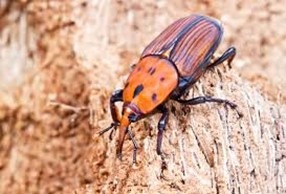
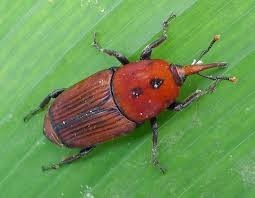
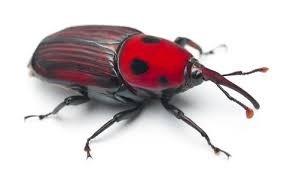
Adults are large (2–4 cm long), reddish-brown weevils with a distinctive long, curved snout (rostrum). Males have a tuft of hairs on the snout tip. They are strong fliers, capable of traveling several kilometers in search of host palms. - Egg Stage:
Females lay 200–300 creamy-white, oval eggs (≈2 mm) singly in holes chewed into the palm trunk, crown, or leaf bases. - Larval Stage:
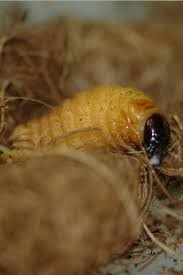
Legless, creamy-white grubs (up to 5 cm long) with a reddish-brown head hatch in 2–5 days and bore into the palm’s soft tissues, creating tunnels filled with frass (excrement and chewed fibers). - Pupal Stage:
After 25–105 days of feeding (depending on temperature), larvae pupate inside fibrous cocoons made from palm fibers, typically at the base of fronds or within the trunk. The pupal stage lasts 14–21 days. - Total Life Cycle:
45–150 days, with multiple overlapping generations per year in warm climates (optimal at 25–35°C).
Damage is primarily caused by larvae, which hollow out the palm’s apical meristem (growing point), leading to structural collapse. Adult feeding is minor but facilitates egg-laying sites.
Early Detection Methods
RPW infestations are notoriously difficult to detect early because larval activity occurs inside the palm.
By the time external symptoms appear, the palm is often beyond saving.
A multi-tool approach combining visual, acoustic, chemical, and technological methods is recommended.
Visual Inspection (Low-Tech, Essential)
- Symptoms on Crown/Fronds:
- Wilting, yellowing, or browning of central (youngest) fronds.
- Notched or chewed leaf bases; frass oozing from holes.
- Collapsed or “umbrella-shaped” crown due to severed petioles.
- Symptoms on Trunk:
- Small entry/exit holes (5–10 mm) with oozing sap or gummy exudate.
- Crunchy sound when pressing the trunk (due to larval tunneling).
- Presence of pupal cocoons at the base of fronds or in leaf axils.
- Best Practice:
Inspect palms monthly, focusing on the crown (use ladders or cherry pickers for tall palms). Remove and dissect suspicious fronds to check for larvae.
Acoustic Detection (High Sensitivity)
Larvae produce distinct chewing and movement sounds inside the trunk.
- Tools:
- Electronic stethoscopes or piezoelectric sensors (e.g., AED-2000, RPW-Detector).
- Smartphone apps with sensitive microphones (e.g., Palm Weevil Detector by CIHEAM).
- Procedure:
- Attach sensor to trunk at 0.5–1.5 m height.
- Record for 30–60 seconds in quiet conditions.
- Analyze for characteristic “crunching” patterns (software can classify signals with >90% accuracy).
- Advantage:
Detects infestations weeks before visual symptoms.
Pheromone Trapping (Monitoring & Mass Trapping)
- Aggregation Pheromone:
Ferrugineol (4-methyl-5-nonanol) attracts both sexes. - Trap Design:
- Bucket traps (10–12 L) with roughened exterior for weevil climbing.
- Contain pheromone lure + kairomone (ethyl acetate or palm tissue) + water/insecticide.
- Service weekly; replace lures every 6–8 weeks.
- Placement:
- 1 trap per 1–2 hectares; 50–100 m apart; 1–1.5 m above ground.
- Avoid direct sunlight; hang in shade near palms.
- Use:
- Monitoring: Track population trends.
- Mass Trapping: Reduce adult numbers (up to 80% in some studies).
Sniffer Dogs (Highly Effective in Plantations)
- Trained dogs (e.g., Belgian Malinois) detect RPW-specific volatile compounds at very early stages.
- Accuracy:
>95% in field trials (Saudi Arabia, Spain). - Cost-effective for large farms; one dog can screen 100–200 palms/day.
Advanced Technologies
- Thermal Imaging:
Larval tunnels create heat signatures; use drones with FLIR cameras at dusk. - X-ray/CT Scanning:
Non-destructive imaging of trunk interior (research phase). - Remote Sensing:
Satellite/drone multispectral imagery to detect canopy stress (NDVI anomalies).
Integrated Pest Management (IPM) Remedies
No single method eradicates RPW.
An IPM strategy combining cultural, mechanical, chemical, and biological controls is essential.
Preventive (Cultural) Practices
- Sanitation:
- Remove and destroy (burn or chip) infested palms immediately.
- Avoid wounding palms during pruning/transport (entry points for weevils).
- Quarantine:
- Inspect imported palms; enforce phytosanitary certificates.
- Treat nursery stock with insecticides before planting.
- Resistant Varieties:
- Some date palm cultivars (e.g., ‘Barhee’, ‘Khalas’) show moderate tolerance.
- Avoid monoculture; interplant with non-host species.
Mechanical Control
- Sanitation:
- Remove and destroy (burn or chip) infested palms immediately.
- Avoid wounding palms during pruning/transport (entry points for weevils).
- Quarantine:
- Trap Trees: Deliberately wound healthy palms to attract weevils, then destroy.
- Crown Injection: Drill into crown and inject insecticides directly (see chemical control).
Chemical Control (Targeted Use)
Insecticides:
Active Ingredient | Application | Notes |
Imidacloprid (Confidor) | Trunk injection or soil drench | Systemic; 6–12 months protection |
Chlorpyrifos | Crown spray/injection | Contact; high efficacy but toxic |
Abamectin | Injection | Low mammalian toxicity |
Phosmet | Foliar spray | Short residual |
Protocol:
Confirm infestation (acoustic/pheromone).
Inject 1–2 ml formulated product per cm trunk diameter.
Repeat every 3–6 months.
Caution:
Rotate chemicals to prevent resistance.
Avoid broad-spectrum sprays that kill natural enemies.
Biological Control
- Entomopathogenic Nematodes (EPNs):
- Steinernema carpocapsae, Heterorhabditis bacteriophora.
- Apply 1–2 million IJs/palm via crown irrigation or injection.
- Efficacy: 70–90% larval mortality in humid conditions.
- Fungi:
- Beauveria bassiana, Metarhizium anisopliae (commercial products: Balsam, Bio-Catch).
- Spray on trunk wounds or inject into tunnels.
- Parasitoids:
Limited success; Scolia wasps under research.
Semiochemical & Biotechnological Tools
- Push-Pull Strategy:
- Repellent (e.g., methyl jasmonate) on healthy palms.
- Attractant traps to pull weevils away.
- RNA Interference (RNAi):
- Experimental: Spray dsRNA targeting essential RPW genes (silences development).
- Experimental: Spray dsRNA targeting essential RPW genes (silences development).
- Sterile Insect Technique (SIT):
- Release irradiated males to reduce reproduction (piloted in UAE).
Step-by-Step Action Plan for South African Farmers
- Establish Monitoring:
- Deploy 1 pheromone trap per 2 ha.
- Conduct monthly visual + acoustic checks.
- Early Infestation:
- Inject imidacloprid + apply EPNs.
- Remove cocoons manually.
- Severe Infestation:
- Fell and chip palm; treat stump with chlorpyrifos.
- Eradicate within 48 hours to prevent adult emergence.
- Area-Wide Management:
- Coordinate with neighbors via DAFF (Department of Agriculture, Forestry and Fisheries).
- Report sightings to RPW hotline or iNaturalist.
The Red Palm Weevil is a stealthy, lethal threat to South Africa’s palm resources, but early detection using pheromone traps, acoustic sensors, and trained dogs can save palms.
Combine this with integrated management—sanitation, targeted insecticides, nematodes, and community coordination—to suppress populations below economic thresholds.
Vigilance and rapid response are non-negotiable: a single undetected infested palm can release hundreds of weevils, reigniting an outbreak.
By adopting these science-backed strategies, growers can protect their livelihoods and preserve iconic palm landscapes.
References:
FAO (2023), EPPO (2024), SA-DAFF Pest Alerts, peer-reviewed studies in Journal of Pest Science and Crop Protection.