
The Majestic Journey of Phoenix canariensis:
A Global History
Author: Johan Grabe Founder and CEO Koingnaas Palms
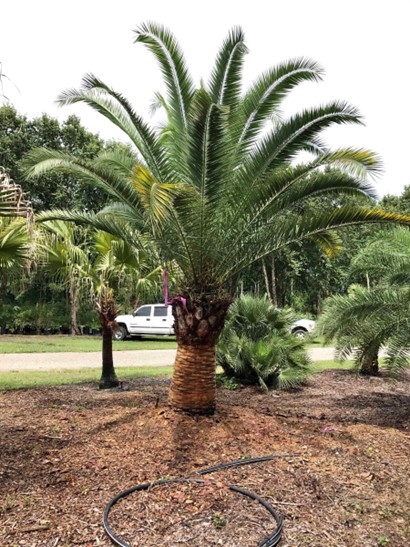
The Canary Island Date Palm (Phoenix canariensis) is one of the most recognizable and widely planted ornamental palms in the world.
Its majestic stature, with a stout trunk and a dense crown of vibrant green fronds, has made it a symbol of tropical and Mediterranean elegance.
This document explores the rich history of this iconic palm, from its origins in the Canary Islands to its status as a global horticultural superstar.
Native Origins and Traditional Uses
As its name suggests, Phoenix canariensis is native and endemic to the Canary Islands, an archipelago off the coast of Northwestern Africa.
It is the natural symbol of the islands, a testament to its deep-rooted presence in the region’s ecology and culture. Long before its global distribution, the palm was a vital resource for the indigenous Guanche people, who skillfully wove its fibrous fronds into baskets, mats, and other essential items.
This tradition of utility continues today, with the palm’s sap being harvested on the island of La Gomera to produce a unique palm syrup (miel de palma), and its fronds used for fuel and other local crafts.
Part of Plant:
Traditional Use
Sap:
Production of palm syrup (miel de palma)
Leaves (Fronds):
Weaving into baskets and mats; used as fuel / firewood
Fruit:
Edible, but not widely consumed due to thin flesh
The Great Dispersal: A Horticultural Phenomenon
The global journey of the Canary Island Date Palm began in the mid-to-late 19th century.
While it was introduced to mainland Europe as early as the 1600s, it was during the Victorian-era “palm craze” that its popularity exploded.
By the late 1860s, it had entered the horticultural market, and by the end of the century, it was being exhibited in botanic gardens and propagated by nurseries across Europe, North America, and Australia.
Its appeal lay in its grand, symmetrical form and its surprising hardiness, which allowed it to be cultivated in a wide range of climates, from the Mediterranean to the cooler oceanic regions of the UK and Ireland.


A Californian Icon: Myth and Reality
Nowhere did the Canary Island Date Palm make a greater impact than in California. It has become so intertwined with the state’s identity that a popular myth attributes its introduction to the Spanish missionary Junípero Serra in 1769.
However, historical records show that while the Spanish missionaries did cultivate the true date palm (Phoenix dactylifera) for its fruit, the Canary Island Date Palm was not introduced to California until much later, first appearing in a San Francisco nursery around 1875.
Stanford University provides a quintessential example of the palm’s role in shaping California’s landscape. In 1893, the university’s first president, David Starr Jordan, proposed lining the main approach, Palm Drive, with palms to evoke a sense of the exotic and amplify the campus’s monumental design. Today, nearly 200 of these majestic palms define the university’s iconic entrance. This story highlights a key aspect of the palm’s history: it was planted not just as a tree, but as a powerful symbol of paradise and grandeur.
When the University opened in 1891, Palm Drive was still known as University Avenue… It was David Starr Jordan, the University’s first president, who suggested the palm theme in 1893. Palms were not yet a distinct cultural emblem of California, of course, but signified instead a broader sense of the exotic
Modern Status: Celebrated and Contested
Today, Phoenix canariensis holds the Royal Horticultural Society’s prestigious Award of Garden Merit, a testament to its enduring ornamental value.
However, its success has also led to challenges.
The palm has naturalized in many regions where it was introduced, including California, Florida, Australia, and parts of the Mediterranean, where it is now considered an invasive species.
Its dense canopy can outcompete native vegetation, and its seeds are readily dispersed by birds and rodents.
Furthermore, in both its native and cultivated ranges, the palm is under severe threat from the invasive red palm weevil (Rhynchophorus ferrugineus), a pest that can kill a mature tree in a matter of months.
This has led to widespread losses and intensive efforts to control the weevil’s spread, highlighting the vulnerabilities that can accompany global horticultural success.
From a sacred resource in the Canary Islands to a global symbol of paradise and a challenging invasive species, the history of Phoenix canariensis is a complex story of nature, culture, and the enduring human desire to shape our landscapes.