
The History of Butia capitata:
A Tale of Two Palms
Author: Johan Grabe Founder and CEO Koingnaas Palms
The history of Butia capitata, commonly known as the Jelly Palm or Pindo Palm, is more complex than it first appears, largely due to a long-standing case of mistaken identity in the world of botany and horticulture.
This page clarifies this taxonomic confusion and provides a comprehensive historical overview of the true Butia capitata and its more famous relative, Butia odorata, with which it is often confused.
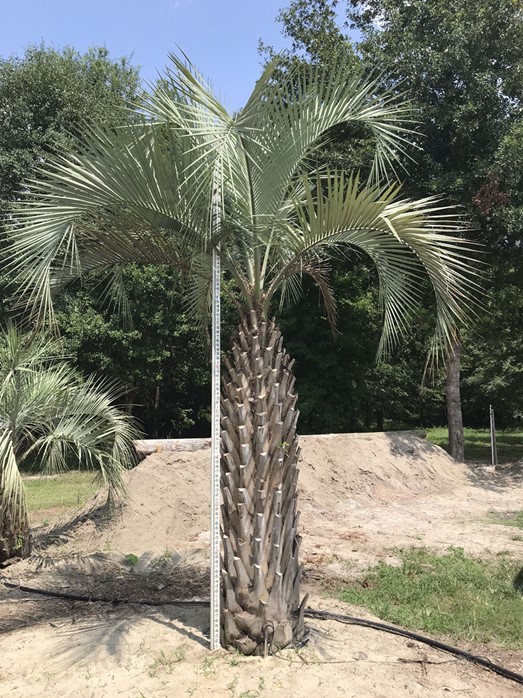

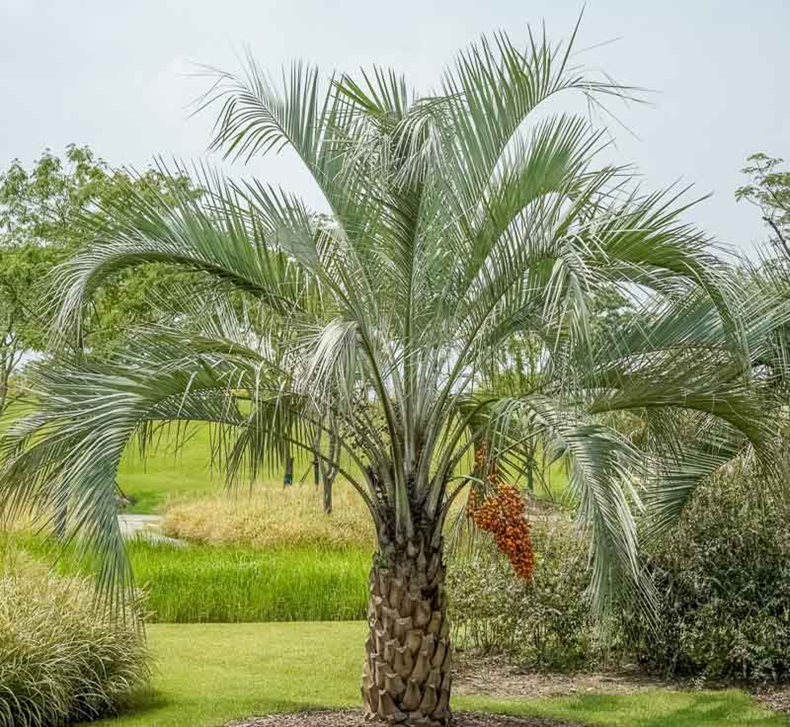
Taxonomic Clarification: Capitata vs. Odorata
A crucial point in understanding the history of the Jelly Palm is the distinction between two species:
- Butia capitata:
The true species, first described by German botanist Carl Friedrich Philipp von Martius in 1826. It is native to the interior savannas (Cerrado biome) of Minas Gerais and Goiás states in Brazil. This species is not widely cultivated and is not particularly cold-hardy. - Butia odorata:
This is the palm almost universally known and cultivated as the “Jelly Palm” or “Pindo Palm.” Native to the coastal regions of southernmost Brazil (Rio Grande do Sul) and Uruguay, it is much more cold-hardy and has been widely distributed as an ornamental plant under the incorrect name B. capitata.
For the remainder of this document, “Jelly Palm” will refer to B. odorata, the commonly cultivated species, while the true B. capitata will be specified as such.
Ancient Origins and Indigenous Use
The relationship between humans and Butia palms in South America is ancient, stretching back thousands of years. Archaeological research in the palm grove landscapes of Uruguay and Brazil has revealed extensive evidence of the palms’ importance to pre-Columbian indigenous peoples.
The role of butia palms was recognised early on by regional archaeology thanks to archaeological records, the ethnographic analogy and the current importance of these resources for local populations.
Palms are constantly present throughout the archaeological records of the Indigenous mounds, to a full spatial and time extent and in different manifestations.
Archaeological findings from as early as 4,600 years ago provide a rich picture of the palms’ role in daily life:
Food Source:
Charred palm nuts (endocarps) and specialized stone tools for cracking them (rompecoquitos) are common finds. Microscopic plant remains (phytoliths) found in ceramic vessels and on human dental plaque confirm the consumption of both the fruit and seeds.
Materials and Rituals:
The discovery of leaf and stem phytoliths indicates that the palms were used for a wide range of purposes beyond food, including construction, industrial fibers, and even burial rituals.
This deep historical connection shows that indigenous communities actively managed and relied upon these palm groves, beginning a process of landscape domestication in the mid-Holocene.
.
Traditional Uses and Cultural Significance
The legacy of the Jelly Palm’s utility continues in the traditional practices of modern communities in its native range. The fruit, known as butiá, is highly prized for its unique flavor, often described as a blend of pineapple, apricot, and vanilla.
Part of Plant | Traditional Use |
Fruit Pulp | Eaten fresh; made into juices, jellies, jams, ice cream, and liqueurs |
Fruit Skin & Fiber | Often discarded, but pulp is processed |
Seeds (Nuts) | Roasted and used as a coffee substitute; oil extracted is similar to coconut oil |
Leaves | Used for weaving, thatching, and artisan crafts |
Palm Heart | Edible, but harvesting is destructive to the stem |
In southern Brazil and Uruguay, the Jelly Palm is a powerful cultural symbol, integral to the identity of the Pampa biome.
It is celebrated in local music, literature, and art. Gastronomic tourism, such as the “Flavours of Rocha” program in Uruguay, now promotes traditional butiá products, from small-batch liqueurs to artisanal jams, connecting modern consumers with the palm’s rich history.
Introduction to Cultivation
The widespread cultivation of the Jelly Palm (Butia odorata) began in the late 19th and early 20th centuries.
Its introduction into the United States and Europe was driven by its remarkable beauty and surprising hardiness for a feather palm.
It quickly became a favorite in Mediterranean climates and the southern United States, where it is now a common sight from Florida to Virginia on the East Coast and throughout California on the West Coast.
Its ability to withstand brief temperature drops to -10°C (14°F) has allowed it to be planted in regions previously thought unsuitable for feather palms, such as the UK and the Netherlands.
Conservation Status
Despite its success as a cultivated ornamental, the native palm groves of Butia odorata in Uruguay and Brazil are under threat.
The landscape is now dominated by centenarian palms with very little natural regeneration, a result of land-use changes and cattle ranching, which prevents seedlings from establishing.
This has placed the entire palm grove ecosystem at risk. While Butia species have been listed as priority for conservation, protecting the vast, interconnected palm grove landscape—a living historical and cultural artifact—requires a more comprehensive approach that integrates ecological, cultural, and economic needs.