
A History of the Mexican Blue Fan Palm
(Brahea armata)
Author: Manus AI
The Mexican Blue Fan Palm, Brahea armata, is a striking and popular ornamental palm celebrated for its distinctive silvery-blue, fan-shaped fronds.
Known by a variety of common names including Blue Hesper Palm, Mexican Blue Palm, and Palma Blanca, it has become a favorite in arid and Mediterranean climates worldwide.
This article delves into the detailed history of this remarkable palm, from its botanical discovery and taxonomic classification to its ethnobotanical significance and cultivation history.
Botanical Discovery and Taxonomy
Brahea armata was first formally described by the American botanist Sereno Watson in 1876.
His description was published in the Proceedings of the American Academy of Arts, officially giving the palm its scientific name.
The specific epithet “armata” is Latin for “armed,” likely referring to the sharp spines found on the petioles (leaf stalks).
Historically, the palm has been known by many synonyms. It was once placed in the genus Erythea, a name derived from Greek mythology.
Erytheia was one of the Hesperides, nymphs who tended a blissful garden at the western edge of the world, a fitting name for a palm from the western edge of the Americas.
However, botanists later subsumed the genus Erythea into the genus Brahea, which is the currently accepted classification.
Feature | Description |
Binomial Name | Brahea armata S.Watson |
Family | Arecaceae |
Genus | Brahea |
Described By | Sereno Watson |
Year of Description | 1876 |
Recent phylogenomic studies have continued to refine our understanding of the Brahea genus, with research suggesting that Brahea armata and Brahea aculeata likely diverged relatively recently in their evolutionary history.
Physical Characteristics
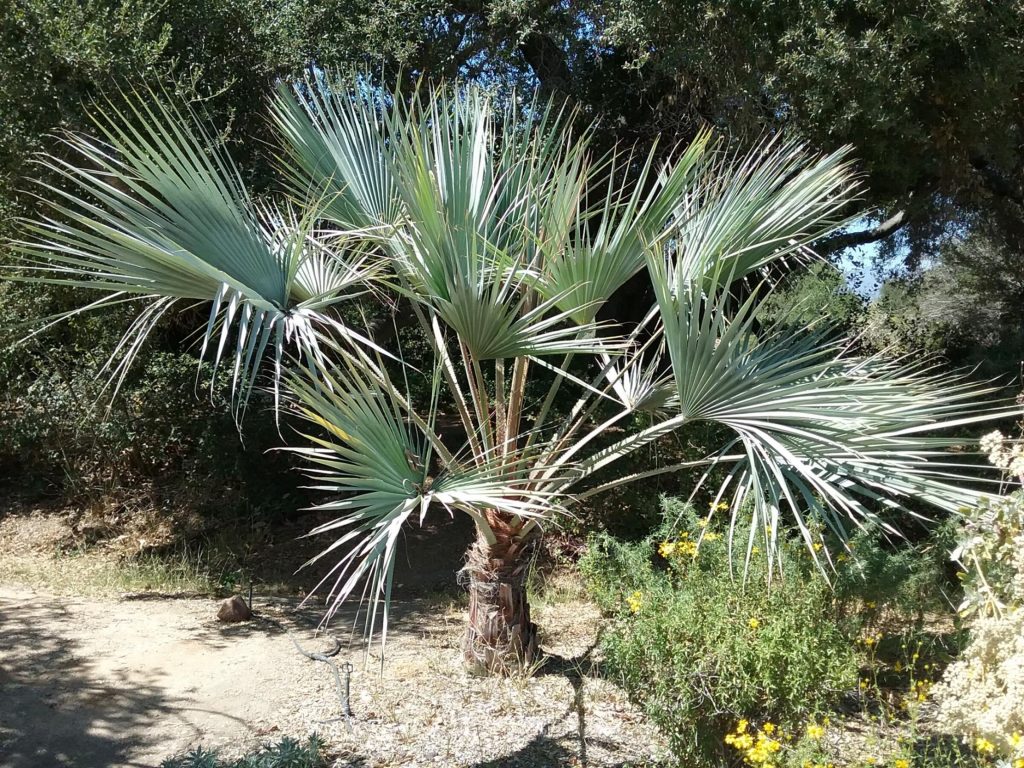
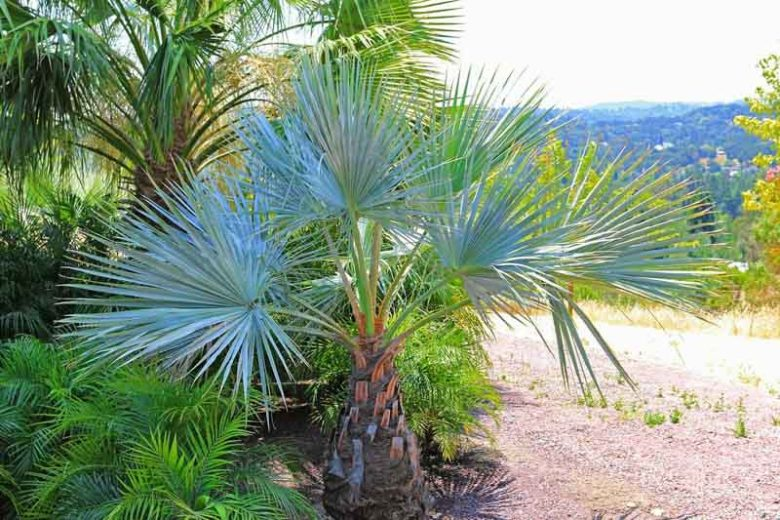
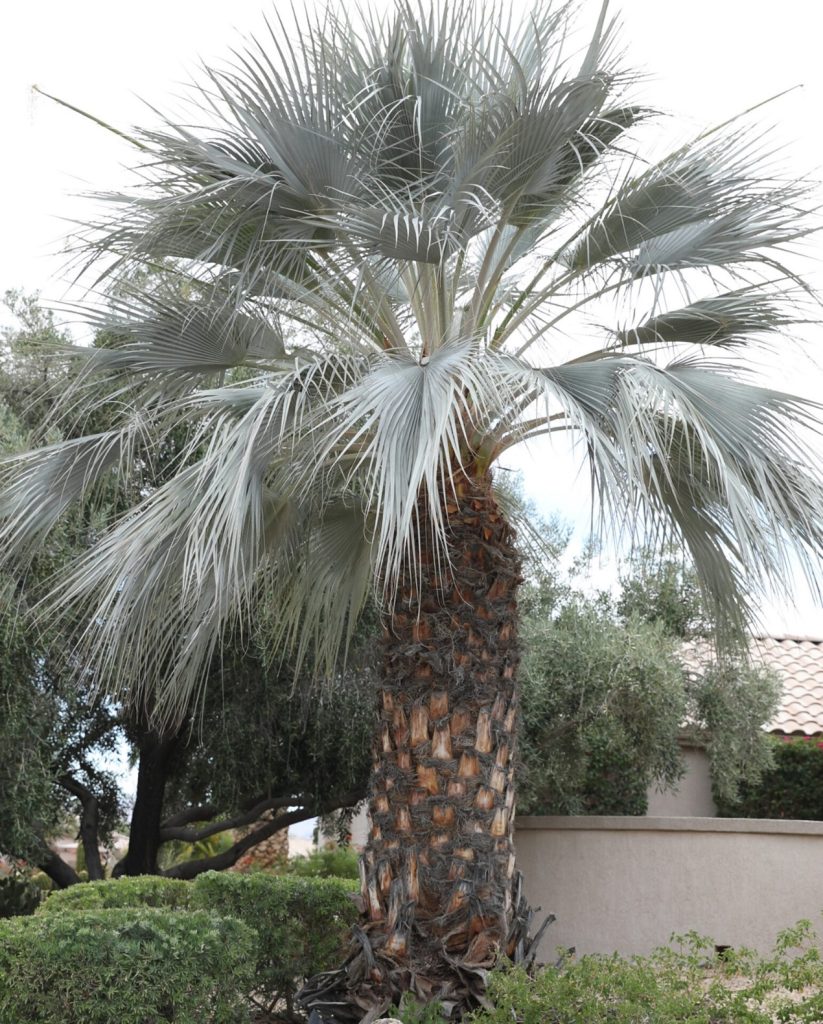
Brahea armata is prized for its dramatic appearance. It is a slow-growing but long-lived palm that can eventually reach heights of up to 15 meters (49 feet).
Its stout trunk is often covered in a “shag” of persistent, dead leaves in its natural habitat, though these are typically removed in cultivation.
The most notable feature is its crown of large, stiff, fan-shaped leaves that are a striking silvery-blue color.
The inflorescences are particularly impressive, extending far beyond the crown in long, arching plumes that can reach 5 meters (16 feet) in length, bearing small, cream-colored flowers.
Native Habitat and Distribution
This palm is endemic to the arid desert regions of Baja California, Mexico.
Its native range extends from the rocky canyons and arroyos just south of the U.S. border down through the central desert and to islands like Isla Ángel de la Guarda.
It is often found growing in rocky crevices and canyon bottoms, sometimes alongside other native palms such as Washingtonia filifera and Washingtonia robusta.
This harsh, dry environment has shaped the palm’s incredible drought tolerance and resilience.
Ethnobotanical Significance
Long before it was a prized ornamental, Brahea armata held cultural significance for the indigenous peoples of the Baja California peninsula.
The Cocopah people, for example, are known to have roasted and eaten the palm’s seeds.
The Kumeyaay also utilized various parts of the palm, incorporating it into their traditional ethnobotanical knowledge.
The fruit, a small, brown, date-like drupe, provided a food source in an otherwise challenging desert environment.
Cultivation History
Brahea armata was introduced to cultivation and quickly gained popularity for its unique beauty and toughness.
It has been planted in gardens in southeastern Europe for many years, with large, mature specimens over 50 years old visible along the French Riviera.
It also became a staple in gardens across the American Southwest.
Despite its desert origins, it has proven adaptable to a range of climates.
It is highly drought-tolerant but can also handle wetter conditions if provided with well-draining soil.
Its hardiness is also notable, with established plants capable of tolerating temperatures down to -10°C (14°F).
Though it has a reputation for being slow-growing, especially in cooler climates, enthusiasts have found that with a warm, sheltered position and good care, it can grow at a respectable rate.
Its ornamental value was recognized with the Royal Horticultural Society’s Award of Garden Merit in the UK.
The history of Brahea armata is a rich tapestry that weaves together botanical exploration, mythological naming conventions, indigenous knowledge, and horticultural passion.
From its discovery in the rugged landscapes of Baja California to its current status as a celebrated ornamental palm across the globe, the Mexican Blue Fan Palm stands as a testament to the enduring appeal of the plant world.
Its journey from a local food source to a global garden specimen highlights its resilience, beauty, and the deep connection between people and plants.